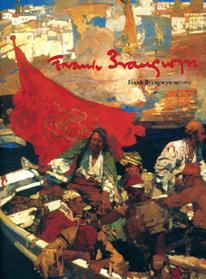
| Frank Brangwyn 1867-1956 celebrates the work of one of Britain’s greatest, yet most unfairly overlooked artists. Originally published by Leeds Museums and Galleries to accompany a major exhibition commemorating the 50th anniversary of his death, the book is now being reprinted due to exceptional demand. This superb full-colour volume presents both a biographical overview and more detailed essays analysing the significance of an artist whose long career, prolific output and mastery of a wide range of media has, paradoxically, led to an undervalued legacy. Sir Frank William Brangwyn RA RWS PRBA HRSA was born Guillaume François Brangwyn in 1867 in Bruges, the son of a Welsh mother and English father. Although mentored by William Morris as a teenager, Brangwyn was largely self-taught, and his first success came when he had a painting accepted by the Royal Academy Summer Exhibition at the age of seventeen. He travelled widely as a young man, before spending the later years of his life in his converted cottage/studio at Ditchling, East Sussex. He was elected to the Royal Academy in 1919 and knighted in 1941. Brangwyn is estimated to have produced more than 12,000 works. As well as being remarkably prolific, the range of his artistry is almost unparalleled. Examples of his genius exist within painting, illustration, mural, printing, architecture, interiors and decorative art, all of which are featured in Frank Brangwyn 1867-1956. There was seemingly nothing that he could not turn his hand to: the muted tones of his seafaring paintings, contrasting with bright, Mediterranean-inspired works such as ‘Buccaneers’. His murals, as seen in St Aidan’s Church, Leeds; New York’s Rockefeller Center, and in the Swansea hall which bears his name and is home to the scandal-causing British Empire Panels. From stained glass to WWI propaganda, Brangwyn’s output is also the story of a man who lived through several art movements – Impressionism, Art Nouveau, Expressionism – and yet was slave to none of them. 2006 marked the 50th anniversary of Brangwyn’s death, commemorated by the exhibition Frank Brangwyn 1867-1956, which was hosted by Leeds City Art Gallery, Arents House, Bruges and Glynn Vivian Art Gallery, Swansea. First published to accompany this exhibition, the book Frank Brangwyn 1867-1956 quickly sold out of its initial run and is now being reprinted due to demand. With an introduction by Gillian Naylor, Frank Brangwyn 1867-1956 offers both a biography and overview of the man’s work by leading scholar Libby Horner, and a collection of essays examining different aspects of his varied career: ‘The Songs of a Wayfarer: Brangwyn’s paintings on exhibition in Britain and abroad, c1885-1905’ (Tim Wilcox) ‘The murals of Frank Brangwyn’ (Alan Powers) ‘Swiftness, vigour and exuberance: Frank Brangwyn and the artist print’ (Corinne Miller) ‘Architecture, interiors and the decorative arts’ (Libby Horner) ‘Frank Brangwyn and his patrons’ (David Boswell) Highly esteemed in his time, especially in mainland Europe, in later years Brangwyn was sometimes wrongly dismissed as eccentric relic of an earlier era. |